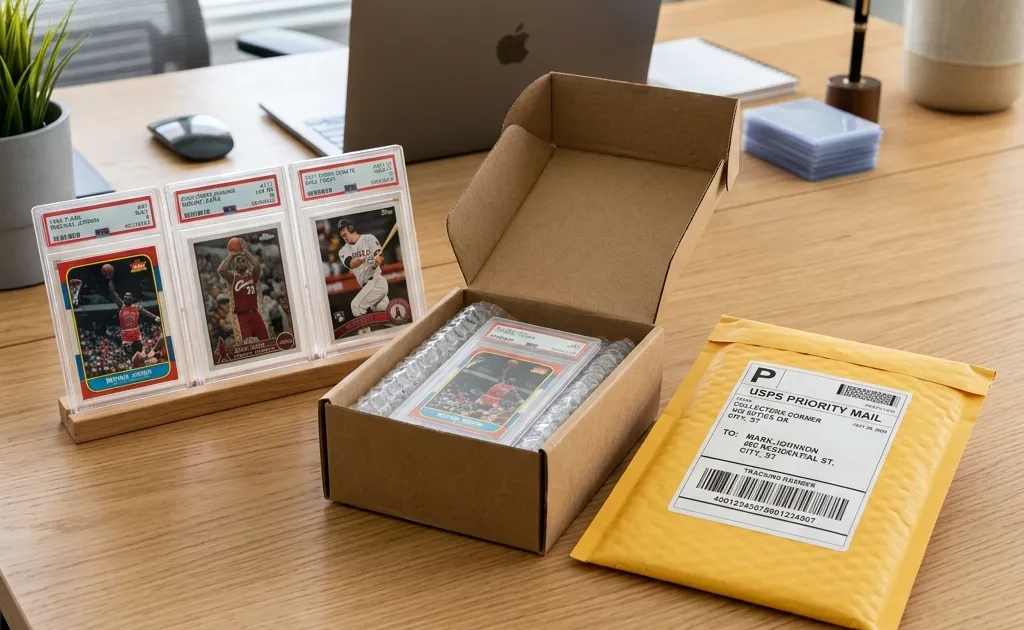
The best way to sell sports cards depends on what you own, how quickly you need payment, and how much work you are willing to do. A well-identified star rookie may deserve an individual online listing. A box of common cards may be better sold as a local lot. A rare graded card may justify a specialist auction house.
Your goal should be the best net result, not simply the highest headline sale price. Fees, shipping, insurance, returns, time, and the risk of damage all affect what you keep.
This guide walks through the complete process: identify and sort the cards, research recent sales, choose a venue, build an honest listing, package the order, and document the transaction.
The short version: a seven-step selling plan
- Identify each promising card by year, set, player, card number, parallel, and grade.
- Separate valuable cards from bulk so you do not spend 20 minutes listing a card worth less than the shipping materials.
- Research recent sold comparables, matching the exact variation and condition.
- Estimate net proceeds after venue fees, supplies, postage, insurance, and possible grading costs.
- Choose the right selling channel for the card’s value, liquidity, and your available time.
- Photograph and disclose condition accurately to reduce returns and build buyer confidence.
- Package, track, and document the shipment according to the marketplace and carrier rules.
Step 1: Identify and sort the collection
Do not price from the player name alone. Record as many of these fields as possible:
- year and manufacturer
- set or product name
- player and team
- card number
- rookie-card designation
- parallel color or pattern
- serial number, such as 17/99
- autograph or memorabilia feature
- grading company and grade, if slabbed
- visible condition notes if raw
A card scanner can provide a useful starting match, but compare the result with the card itself. Check the back for the card number, copyright year, set wording, and serial stamp. Our sports card valuation guide explains how to avoid mixing base cards with more valuable parallels.
Then sort into practical groups:
| Group | Typical strategy |
|---|---|
| High-value, liquid singles | Individual fixed-price listing, auction, or specialist consignor |
| Mid-value stars, rookies, parallels | Individual listings or small player/team lots |
| Low-value but desirable cards | Combined lots, set-building groups, or low-cost marketplace listings |
| Commons and duplicate base cards | Local bulk sale, team lots, donation, or included extras |
| Uncertain vintage or potentially altered cards | Authentication or expert review before making claims |
Step 2: Find realistic sold comparables
Search for the exact card and filter for completed or sold transactions. eBay’s official pricing guidance says its sports-card price guidance uses market data and is updated daily, but you should still inspect the individual listings behind any estimate.
Use comparable sales that match:
- the exact set, card number, and parallel
- raw versus graded status
- the same grading company and grade
- autograph or relic status
- serial-number range when scarcity differs materially
- similar visible condition for raw cards
Exclude or treat cautiously:
- active asking prices with no buyer
- multi-card lots when you need a single-card value
- vague listings with stock photos
- best-offer results when the accepted amount is unclear
- damaged copies compared with clean copies
- suspiciously high sales with no supporting market pattern
Use several recent sales when possible. If matching transactions are scarce, widen the date range and lower your confidence rather than pretending a precise value exists.
Step 3: Calculate what you will actually keep
Before choosing a venue, make a simple net-proceeds estimate:
Expected sale price − marketplace fees − payment fees − promotion fees − shipping subsidy − supplies − insurance − consignment fee = estimated net proceeds
Marketplace rules change. eBay’s current seller-fee documentation explains that fees depend on category, price, listing setup, seller performance, and store status. Check the live fee schedule rather than copying an old percentage from a forum or video.
Also value your time. Photographing, listing, answering questions, packing, and reconciling 100 inexpensive cards may earn less than selling them as a single organized lot.
Where to sell sports cards
Online marketplace: broad reach and more work
Large marketplaces work well for cards with clear demand because many buyers can find them. You control photos, title, price, shipping, and timing, but you also handle condition questions, packaging, and returns.
Best for: recognizable singles, graded cards, player or team lots, and cards with enough value to justify the labor.
Tradeoff: broad exposure can improve the gross price, while fees and seller work reduce the net.
Local card shop: speed and simplicity
A local card shop can inspect cards and make an immediate offer. The offer must leave room for the shop’s overhead, holding period, and resale risk, so it will generally be below the expected retail selling price.
Best for: collectors who value speed, safety, and a single transaction more than maximizing every card.
Tradeoff: convenient payment in exchange for a wholesale-style price. Ask whether the offer is cash, store credit, or consignment and get the terms in writing for a major collection.
Card show: direct negotiation
At a show, you can sell to dealers or collectors without shipping. Organize cards by price before arriving and know your minimum acceptable net amount. Keep high-value cards secured and do not leave a trade box unattended.
Best for: liquid singles, trade-friendly cards, and sellers comfortable negotiating.
Tradeoff: travel, admission or table cost, and inconsistent buyer demand.
Consignment service or auction house: less handling
Consignors photograph, list, collect payment, and ship on your behalf. Some specialize in graded cards or premium memorabilia; others accept large volumes. Compare commission tiers, intake or processing fees, insurance, payout timing, unsold-item policies, and the venue where the card will appear.
Best for: large collections, premium cards, or sellers who prefer to outsource the work.
Tradeoff: less time spent selling, but less control and a potentially longer payout cycle.
Collector groups and local marketplaces: targeted but risk-sensitive
Groups can connect you with knowledgeable buyers and reduce some venue costs. They can also offer fewer formal protections. Follow group rules, check references, use documented payment methods, and meet in a safe public location for in-person transactions.
Best for: niche cards, local lots, and experienced sellers who can verify counterparties.
Tradeoff: efficient access to a community, with more responsibility for fraud prevention and dispute handling.
Fixed price or auction?
Choose a fixed price when comparable sales establish a reasonable range and you can wait for the right buyer. Allowing offers can reveal demand while preserving a minimum.
An auction can work when the card is scarce, timely, or supported by multiple interested buyers. It can also finish below expectations when the audience is small or the listing ends at a poor time. Do not use a low-start auction merely because you are unsure of the value; research first.
How to create a listing that earns trust
Write an exact title
Put the searchable identifiers first. A useful pattern is:
Year + set + player + card number + rookie/parallel + grade or key attribute
Example: 2020 Panini Prizm Justin Herbert #325 Silver Prizm Rookie PSA 9
Use only attributes visible on the card or slab label. Do not add “eBay 1/1,” “invest,” “PSA 10?” or other speculative phrases.
Photograph the actual card
Use bright, indirect light and a clean neutral background. Include:
- full front
- full back
- all four corners when condition matters
- angled surface views for scratches, dimples, print lines, or foil defects
- serial number, autograph, patch, or grading label
- any flaw mentioned in the description
Avoid filters, heavy contrast, reflections, or a sleeve that hides surface condition. A clear disclosure may reduce the price slightly but is far cheaper than a return or payment dispute.
Complete item specifics
Fill in the sport, league, player, set, year, card number, manufacturer, features, parallel, team, and grade fields accurately. These fields help marketplace filters and reduce buyer uncertainty.
Describe condition, do not grade a raw card
For an ungraded card, describe what you can observe: “light whitening on lower-right back corner” or “surface line visible under angled light.” Do not promise that a raw card will receive a particular professional grade. Include a direct statement that buyers should review the photos.
How to package sports cards safely
The package should prevent surface contact, movement, bending, moisture exposure, and escape from the holder.
For a standard raw single
- Put the card in a clean penny sleeve.
- Insert it into a correctly sized toploader or approved semi-rigid holder.
- Place the holder in a resealable team bag. If using removable tape, create a pull tab and keep adhesive away from the card.
- Add rigid support appropriate for the shipping service.
- Put the protected card into a mailer that meets the carrier and marketplace rules.
Use our sports card thickness chart if the card does not fit a standard holder.
For graded or valuable cards
Place the slab in a fitted sleeve, protect it with padding, and use a sturdy box with no empty movement. For a high-value transaction, consider signature confirmation and insurance after checking the marketplace’s seller-protection requirements. Photograph the card, packing stages, sealed package, and label.
When eBay Standard Envelope is appropriate
eBay’s official Standard Envelope rules currently allow eligible trading-card orders within specific price, weight, thickness, rigidity, and quantity limits. The help page states that graded cards are not eligible and provides the current protection limits and envelope dimensions. Review that page immediately before shipping because prices and eligibility can change.
Do not turn a letter-rate envelope into a rigid parcel with excessive cardboard. If the protected card cannot meet the service requirements, choose a tracked package service instead.
Before-you-list checklist
- Exact card, variation, serial number, and grade confirmed
- Recent sold comparables saved
- Expected net proceeds calculated
- Front, back, corners, surface, and flaws photographed
- Title and item specifics match the card
- Condition described without promising a grade
- Shipping method fits value and package dimensions
- Supplies ready before the listing goes live
- Return and handling settings reviewed
After-the-sale checklist
- Confirm the paid order inside the marketplace, not through an email link
- Check the buyer address against the order record
- Photograph the card and packing process
- Use the marketplace label when required for protection
- Upload or verify tracking
- Keep the receipt and shipment record
- Record sale price, fees, shipping cost, and net proceeds
Common selling mistakes
Pricing from active listings
An unsold asking price is not proof of market value. Start with recent completed sales and adjust for the exact variation and condition.
Listing the wrong parallel
Color, refractor pattern, foil stamp, card number, and serial numbering may distinguish a common base card from a scarce version. If uncertain, avoid an unsupported claim and seek confirmation.
Grading every old card
Grading only makes financial sense when the likely increase in net value exceeds grading, shipping, insurance, and waiting costs. Pre-screen condition and compare realistic grade outcomes.
Hiding flaws
Condition surprises create returns. Make defects easy to see and describe them plainly.
Choosing shipping after the sale
Know the packed weight, dimensions, value, and required protection before publishing. The cheapest service is not cheaper if it voids protection or damages the card.
Frequently asked selling questions
What is the easiest way to sell a sports card collection?
A reputable local shop or consignor is usually easiest because one party handles many cards. Sort and identify the best cards first so the bulk does not obscure the value.
Where can I sell cards for the most money?
Selling individual cards directly to end buyers can produce a higher gross price, but not always a higher return per hour. Compare net proceeds and the time required across marketplaces, shows, and consignment.
Should I sell cards individually or as a lot?
List valuable and liquid singles individually. Group lower-value cards by player, team, set, year, or theme so the lot has a reason for a collector to buy it.
Should I grade a card before selling it?
Consider grading when authenticity or grade meaningfully affects demand and the card has enough potential value to cover all costs. Compare conservative outcomes, not only the highest possible grade.
The bottom line
To sell sports cards well, identify first, use real sold evidence, calculate net proceeds, disclose condition, and choose a shipping method that matches the card. The highest-value strategy is different for a $5 insert, a $100 raw rookie, and a four-figure graded card.
You can use the Sports Card Scanner & Value app to begin identifying and organizing cards before researching comparables. Treat any automated match or estimate as a starting point, then verify the exact card and current market evidence before listing.
Get Instant Sports Card Values
Download the Sports Card Scanner & Value app to instantly identify, catalog, and track your baseball, basketball, and football cards using your phone camera.