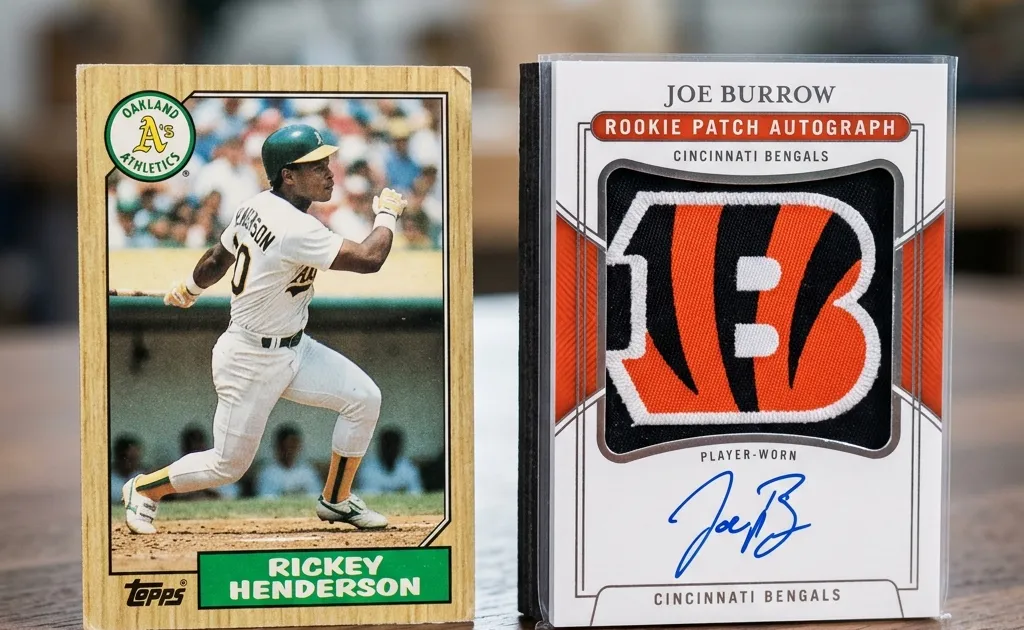
Sports card thickness determines which sleeve, toploader, semi-rigid holder, or magnetic case will protect a card without squeezing it or letting it rattle. Standard base cards are often around 35pt, while memorabilia and patch cards may be 100pt, 130pt, 180pt, or thicker.
The safest rule is simple: identify the card’s thickness before forcing it into any rigid holder. If the card meets resistance, stop. A holder that is too tight can damage corners, edges, foil, or a raised patch. A holder that is much too loose can let the card move and strike the sides.
This guide explains point sizes, gives a practical sports card thickness chart, and shows how to choose a holder when the exact specification is unknown.
Quick sports card thickness chart
The chart below is a starting point, not a guarantee. Manufacturers can use different stock within the same product, and an autograph, relic, acetate layer, or raised surface may change the fit.
| Card thickness | Inches | Common examples | Holder to test first |
|---|---|---|---|
| 20pt–24pt | 0.020–0.024 in | Some vintage and thin paper-stock cards | Standard penny sleeve; vintage-size holder if dimensions differ |
| 35pt | 0.035 in | Most modern base cards, many chrome cards and thin inserts | Standard sleeve and 35pt toploader |
| 55pt | 0.055 in | Premium stock, some chrome inserts and thicker paper releases | 55pt toploader or correctly sized magnetic holder |
| 75pt–79pt | 0.075–0.079 in | Thin relics, some autographs and layered inserts | Thick-card sleeve and 75pt/79pt holder |
| 100pt | 0.100 in | Many jersey and memorabilia cards | Thick-card sleeve and 100pt holder |
| 120pt–130pt | 0.120–0.130 in | Patch autographs, premium relics and manufactured patches | Thick-card sleeve and 120pt/130pt holder |
| 180pt | 0.180 in | Extra-thick patches and premium memorabilia cards | 180pt holder designed for thick cards |
| 240pt–360pt | 0.240–0.360 in | Oversized memorabilia, shoe or equipment pieces, and unusual premium cards | Specialty holder matched to the product |
If a manufacturer offers 79pt rather than 75pt, or 120pt rather than 130pt, use the size specified for that holder. A small difference matters more in a rigid magnetic case than in a flexible sleeve.
What does “pt” mean for sports cards?
In card-holder sizing, one point represents one-thousandth of an inch. That means:
- 35pt = 0.035 inches
- 75pt = 0.075 inches
- 100pt = 0.100 inches
- 130pt = 0.130 inches
- 180pt = 0.180 inches
To convert points to millimeters, multiply the point value by 0.0254. For example, 100pt is 2.54 mm and 130pt is about 3.30 mm.
“Point size” describes thickness, not the card’s height and width. Most modern sports cards are approximately 2.5 by 3.5 inches, but tobacco cards, vintage issues, mini cards, oversized cards, and booklets may require different dimensions even when their thickness is known.
How to measure a sports card
Method 1: Use a printed thickness gauge
A printable gauge is the easiest low-cost method. Card-supply manufacturers such as BCW publish guides that let you compare the exposed edge of a card with common point sizes.
- Download the gauge from a card-supply manufacturer.
- Print it at 100% or “actual size.” Do not use “fit to page.”
- Check the printer scale against a ruler before trusting the result.
- Stand the card’s edge beside the printed blocks without pressing on it.
- Choose the closest holder size that does not compress the card.
Printing at the wrong scale is the most common failure. If the reference measurement on the page does not match a physical ruler, reprint it.
Method 2: Use a digital caliper carefully
A digital caliper gives a direct measurement, but its jaws can mark a card. Do not clamp a valuable raw card. Use clean, smooth jaw covers, close the jaws with minimal pressure, and measure near a structurally safe edge rather than over an autograph, patch, or embossed area.
Convert inches to points by multiplying by 1,000. A reading of 0.128 inches is approximately 128pt, so a 130pt holder is the logical size to test.
Method 3: Compare without measuring
If you already own clean holders in several sizes, compare the card’s edge with the opening before inserting it. Never use the card itself as a wedge. A correctly sized sleeve should slide in without bending a corner, and a correctly sized toploader should accept the sleeved card with light, controlled pressure.
Some collectors compare thickness with coins, but that method is only a rough check. The U.S. Mint lists a cent at 1.52 mm thick, which is close to 60pt. A card may still need a different holder because patches compress differently and rigid cases have fixed recess depths.
How to choose the right protective holder
Penny sleeves
Use a sleeve as the first layer for most raw cards. Standard sleeves fit common base cards; thick-card sleeves have wider openings and more room for relics. Do not stretch a standard sleeve around a thick card. The sleeve seam can catch a corner or press against an edge.
For valuable cards, consider cutting a tiny diagonal opening at one upper corner of a disposable sleeve before insertion. This can reduce the chance that a sharp sleeve corner catches the card. Never cut while the card is inside.
Toploaders
Toploaders provide rigid protection while still allowing a sleeved card to be removed. Match both the point size and card dimensions. The card should slide down without tapping, shaking, or pushing hard. Use a resealable team bag around the finished toploader rather than adhesive tape directly across the opening.
If the card stops halfway, do not push it with a finger or another card. Turn the holder downward over a protected surface and let gravity help remove it. If it remains stuck, a professional card shop may be safer than improvising with tools.
Magnetic one-touch holders
Magnetic holders have a recessed card well and very little tolerance. The recess should be at least as deep as the card, but not so deep that the card moves when the closed case is gently tilted. Check the holder manufacturer’s instructions because some magnetic cases are designed for a bare card while others accommodate an inner sleeve.
Before closing the case, confirm that no corner sits on the lip of the recess. Close the lid slowly and stop if it rocks, bows, or will not sit flush. Never snap a magnetic case shut over a raised patch.
Semi-rigid holders
Semi-rigid holders are commonly used for submissions because they keep a card secure while allowing controlled removal. Follow the receiving company’s current packing instructions rather than assuming a particular holder is accepted. Grading and consignment requirements can change.
Common sizing mistakes
Assuming every chrome card is 35pt
Chrome-style cards may use different stock, acetate layers, or surface treatments. Check the actual card, especially for inserts, autographs, and parallels.
Choosing a larger case “to be safe”
Extra space is not always safer. Repeated movement can wear edges and corners. If the next available size leaves noticeable play, use a compatible inner sleeve or choose a different holder system—never add loose paper or makeshift padding against the card.
Forgetting the sleeve changes the fit
A sleeve adds a small amount of thickness and friction. Test the same combination you intend to store: card plus sleeve plus holder. Do not size a holder using a bare card and then force the sleeved card into it.
Using tape that can touch the card
Adhesive can migrate, leave residue, or catch a card as it is removed. Use a team bag or a purpose-made resealable closure. If tape is necessary for shipping, place a removable pull tab on the outside and keep adhesive away from the card opening.
Ignoring surface features
A raised autograph, patch window, medallion, or embossed element can be the highest point of the card. Measure the maximum thickness and make sure the holder does not press on that feature.
Storage checklist by card type
| Card type | Sleeve | Rigid protection | Extra caution |
|---|---|---|---|
| Standard raw base card | Standard penny sleeve | 35pt toploader or binder page | Avoid crowded binder rings |
| Chrome or foil card | Standard or premium sleeve | Size-tested toploader | Check for surface scratches |
| Autograph card | Sleeve that does not catch ink | Correct-size toploader or UV-resistant magnetic holder | Keep away from prolonged light |
| Relic or patch card | Thick-card sleeve | Exact-size thick toploader or magnetic holder | Do not compress the patch |
| Graded card | Slab sleeve | Graded-card box | Match the box to slab dimensions |
| Booklet card | Manufacturer-compatible sleeve | Specialty booklet holder | Support the hinge and both panels |
Once protected, store cards upright in an appropriately sized box in a stable, dry indoor environment. Avoid attics, garages, direct sunlight, and places with rapid temperature or humidity swings. Our sports card storage guide covers longer-term collection care.
Frequently asked thickness questions
What thickness is a standard sports card?
Many modern base cards fit a 35pt holder, but “standard” is not universal. Vintage stock, chrome releases, inserts, and parallels may differ. Measure or test the individual card when value or condition matters.
Should I round up the holder size?
Choose the smallest holder that accepts the sleeved card without pressure. If a measured card falls between available sizes, moving to the next size is safer than compression, but check for excessive movement.
Can a 130pt card fit in a 100pt holder?
It should not be forced into one. The smaller holder can compress the card or prevent a magnetic case from closing flat. Use a 130pt-compatible product after confirming the measurement.
Do graded cards use point sizes?
The card inside still has a thickness, but slab storage is normally selected by the grading holder’s outside dimensions. Use sleeves, boxes, and bags made for the specific slab format.
The bottom line
Measure first, sleeve without force, and select the smallest rigid holder that protects the card without compression or movement. Point size is only one part of the fit; card dimensions, raised features, sleeve thickness, and holder design also matter.
After the card is protected, use the Sports Card Scanner & Value app to identify the release and organize the collection. Identification can help you research the right variation, but always confirm the physical card and holder fit yourself.
Get Instant Sports Card Values
Download the Sports Card Scanner & Value app to instantly identify, catalog, and track your baseball, basketball, and football cards using your phone camera.